
What 2,118 Oregonians told us they need to take part in public life, and what we built in response.
Since 2018, the Agora Journalism Center has visited seven Oregon communities to ask how people find local news, whom they trust and what goes uncovered. The places range from a newly incorporated town to a farm town, a mill town, a coastal city, a county, a valley and a capital city. Many of these information needs assessments were done in partnership with the University of Oregon’s Sustainable City Year Program.
What we heard was remarkably consistent. Oregonians know more about what is happening in their community than about how to act on it. Information is fragmented, and readers have to piece it together. Trust rests on craft. Emergencies expose every gap. Much of the real information still moves through trusted networks of neighbors, libraries and coffee shops, and the people served worst know it. In every community, the question came back in one form or another: where do we find news we can actually use?
Residents have jobs to do. They hire journalism to get those jobs done. Grouped by job, Oregonians asked for eight things. We call them The Eight Dimensions of a Civic Story:
- Show me how to take part, and who I’d be taking part with.
- Show me how the reporter knows what they know.
- Tell me something I can act on today.
- Show me who decided, and hold them to account.
- Show me what could actually change.
- Make sure I see myself in this, and my neighbors too.
- Show me what’s already working.
- Help me see the whole system.
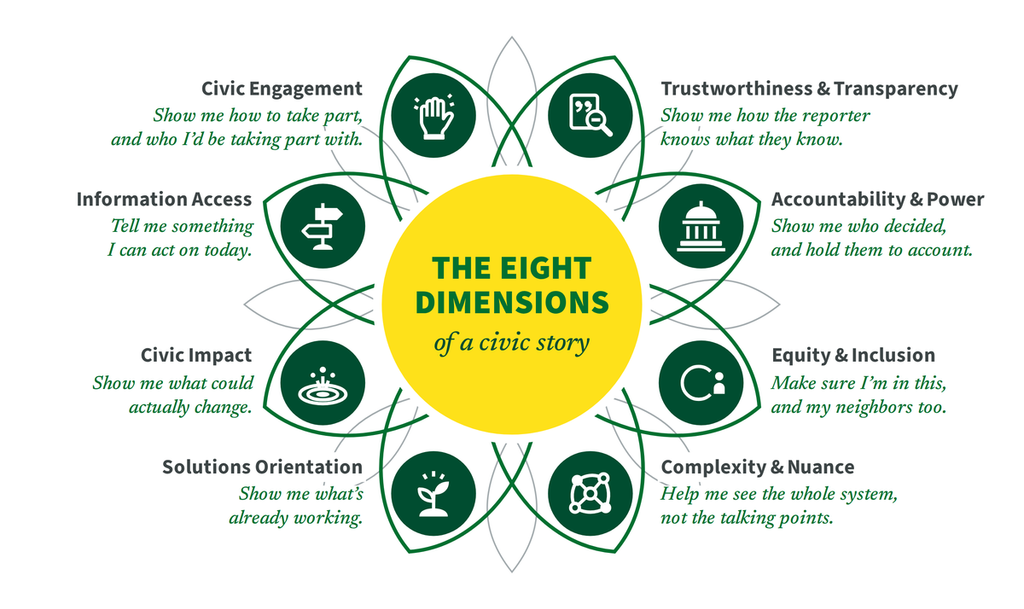
We built the Civic Story Rubric around those eight jobs. Each dimension comes with the signals that show a story doing that job well. Reading what newsrooms publish every day across 36 counties takes help, so the work is AI-assisted. An AI model reads each story against the rubric and cites evidence from the story’s own text. We follow a principle from Audrey Tang‘s work: technology assists, people decide. People set the checks a story must clear, design the rubric and correct the model when it gets a detail wrong. A validity study is now comparing the system’s civic scores with independent human coders, and its findings will shape the next revision.
The rubric powers two things. First, the Oregon Civic Beat is a weekly newsletter that came first because all seven communities asked for the same thing: one reliable place to start. Each issue gathers the week’s stories that do the most civic work and leads with the job each one does: a story that shows you how to take part, one that shows you who decided, one you can act on today. Every story links back to the newsroom that reported it, and an editor reviews every issue before it goes out.
The second is the Oregon Civic Newsstand, the fuller version. It reads what newsrooms publish each day across all 36 Oregon counties and describes each story by The Eight Dimensions of a Civic Story. That lets you find local reporting by what it helps you do and browse by region, theme or outlet. Each assessed story carries a civic value label: High, Notable or Emerging. Civic value is one of many things good journalism does; the label names the civic work in a story, and editors and readers judge the craft. Anyone can browse This Week and This Month. A free membership adds Today and Yesterday, each story’s civic value and its full assessment. Members can flag a card when we get a detail wrong, and they receive the Beat each week. The Newsstand opens to the public November 1, 2026.
The full report tells the whole story in Oregonians’ own words: each finding, where every dimension came from, how a story gets read, what the rubric leaves out and what comes next. To read the full report, click the “Read the Report” link to the right.
Watch: The Eight Dimensions of a Civic Story
On October 15, 2026, Andrew DeVigal took the stage at frank x Portland, a gathering of strategists and storytellers working on social change, hosted by the University of Florida’s Center for Public Interest Communications. In this short talk, he walks through the eight civic jobs Oregonians described, from showing how to take part to showing who decided and how they shaped the Oregon Civic Newsstand.
Editor’s note: This video combines two recordings. The first two minutes and 20 seconds, including the introduction from the Frank organizers, are from the live Frank Gathering in Portland, Oct 2026. The rest of the talk is a studio recording of the same presentation, edited to pair with the slides shown on stage. I re-recorded the talk so the ideas come through more clearly and in less time than my live delivery allowed. The content and argument are the same as what the audience heard that day.